Solutions for hard-to-recycle waste
Let's talk.
We turn risk into value by converting carbon-rich waste into useful feedstock — offering a disposal route that is competitive long-term and aligned with tightening climate and circularity regulations.
Cost & Regulatory Risk of Disposal
Incineration and landfill are facing rising CO₂ prices. Using Cyclize as an additional outlet helps secure a long-term, competitive disposal route and reduces your exposure to future cost and regulatory risks.

Scope 3 Emissions (end-of-life)
End-of-life treatment of products and waste streams contributes to Scope 3 emissions. Routing suitable carbon-rich waste to Cyclize instead of incineration enables lower associated emissions and can be reflected in your value-chain climate reporting.
.svg)
Net-Zero Strategy
Net-zero roadmaps require options that go beyond efficiency measures. Treating carbon-rich waste as feedstock for non-fossil syngas supports your transition away from fossil carbon and can be integrated as a tangible measure in your net-zero strategy.
.svg)
Carbon Circularity
Cyclize closes the loop for carbon: instead of being burned or landfilled, the carbon in your waste is converted into syngas and used as a secondary raw material in chemical production. This directly supports circular economy goals and circularity or recycled-content claims.
.svg)
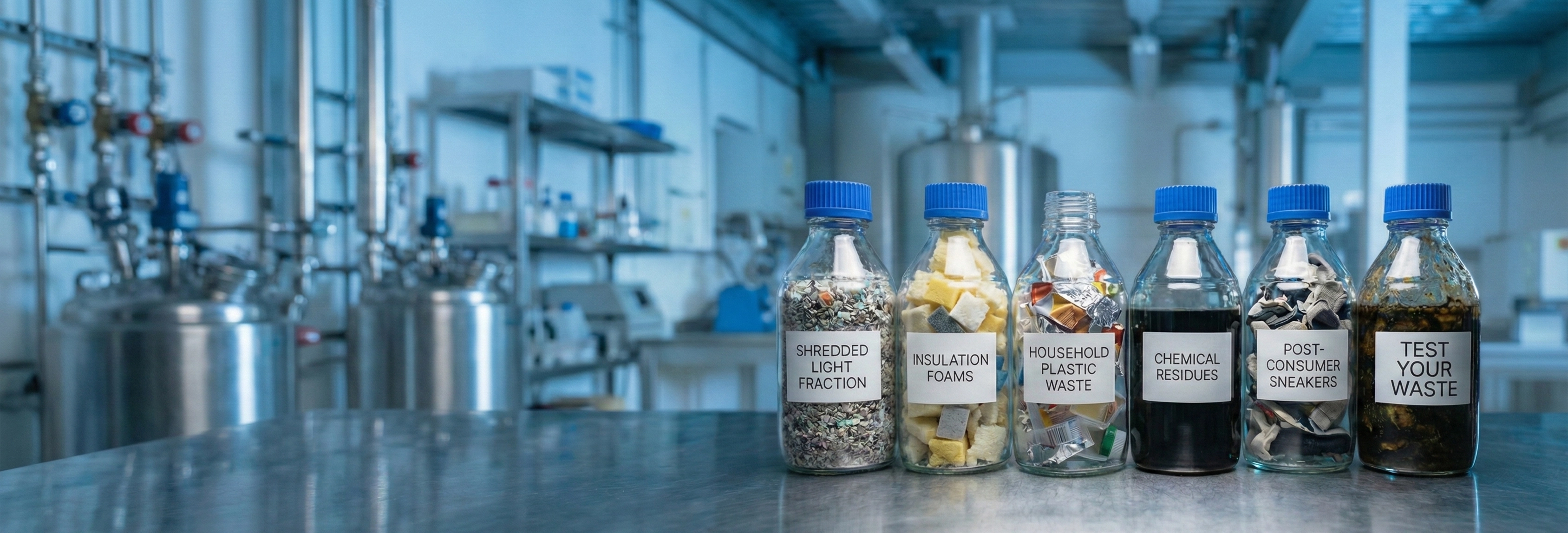
Test Your Waste
Let's check if your waste is recyclable after all.
Get to know
our solutions
Plastic
We focus on plastic streams (solid or fluid) that are hard to recycle mechanically: mixed, contaminated or multi-layer materials. In our process, their carbon content is recovered as syngas, creating a secondary raw material. This syngas is a standard feedstock for the chemical industry and can be used in existing infrastructure.

Residues
Beyond plastics, Cyclize targets feedstocks with high carbon recovery potential from a large variety of sectors like chemical, petrochemical, steel, cement, agriculture: organic slurries, liquid residues, gaseous by-products and biomass-derived streams. After plasma conversion, the recovered carbon is available as syngas for established downstream processes.
CO₂ Emissions
CO₂ from high-temperature processes such as cement and steel production is often treated only as a climate liability (and is basically "waste"). Cyclize integrates this CO₂ into its plasma process, combining it with other waste streams to make use of it to generate circular syngas, a basic feedstock for the chemical industry.