Biogenic Syngas From Waste for climate-neutral steel production
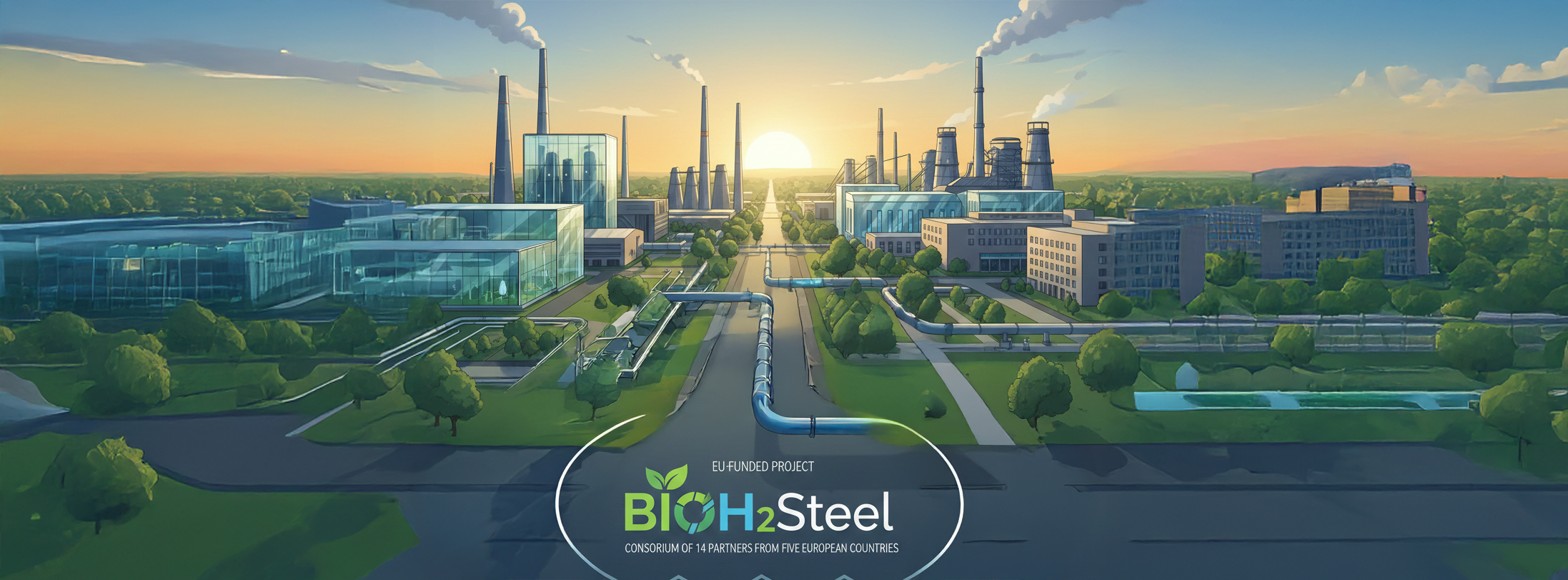
Stuttgart, Germany – Cyclize GmbH is proud to announce its partnership in the European research consortium project BioH2Steel, approved in December 2025. The project investigates the integration of biogenic, hydrogen-rich syngas into steel production. The primary objective is to further decarbonize the Direct Reduction of Iron (DRI) by replacing fossil natural gas with syngas derived from biomass and waste streams.
The project is funded under the Energy Research Program by the Federal Ministry for Economic Affairs and Climate Action (BMWK) and is managed by the Project Management Jülich (PtJ). The project will run for 36 months, from December 2025 to November 2028. BioH2Steel has been granted a total funding amount of €3.91 million, of which nearly €200,000 will be allocated to Cyclize.
Biogenic Hydrogen and Carbon Monoxide: The Keys to "Green Steel"
The iron and steel industry is responsible for approximately 7% of global CO2 emissions, with the majority resulting from carbon-intensive blast furnace processes. Shifting to Direct Reduction of Iron (DRI) using hydrogen is considered a central lever for the industry's decarbonization. While current DRI processes predominantly rely on reformed methane, BioH2Steel addresses the next technological leap: the use of biogenic hydrogen from waste and biogenic residues.
At the heart of the project is Sorption-Enhanced Gasification (SEG), which produces an $H_2$-rich syngas with integrated CO2 separation. In an advanced Oxy-SEG variant, the process is operated with oxygen instead of air to further increase gas quality and efficiency. Thus, BioH2Steel combines decarbonization, waste recovery, and the circular economy in an integrated industrial approach.
The Role of Cyclize: Plasma Gas Cleaning and CO2 Utilization
Cyclize contributes its unique expertise in plasma-based gas conditioning to the project. The focus lies on the purification and conditioning of bio-syngas for use in DRI processes, as well as the further utilization of Cyclize contributes its unique expertise in plasma-based gas conditioning to the project. The focus lies on the purification and conditioning of bio-syngas for use in DRI processes, as well as the further utilization of CO2.
Within the project, plasma reforming and electrochemical cleaning processes (E-Scrubbing) are being developed and tested to remove tars, pollutants, and residual CO2 from the raw gas. The goal is to achieve an industrial-grade syngas quality that allows for direct use in steel production while simultaneously opening new pathways for Carbon Capture and Utilization (CCU).
International Demonstration Along the Entire Value Chain
The international collaborative project "BioH2Steel" is a partnership between 14 partners from five European countries. An interdisciplinary team of four universities, two research institutes, six SMEs, and two major steel industry corporations is conducting the project.
- In Poland, biomass is pre-treated and torrefied.
- In Austria, SEG gasification of sewage sludge, including comprehensive gas cleaning, is being investigated for the first time.
- In Germany and Denmark, an integrated Oxy-SEG-to-DRI system is demonstrated in combination with innovative bio-syngas cleaning technologies.
- In Sweden, a supplementary CO2 cracking approach is being tested for the material utilization of captured carbon dioxide.
- Application is being tested by various steel manufacturers.
The project addresses the key objectives of the Clean Energy Transition Partnership (CETP), particularly energy-efficient industrial systems, the prevention of carbon emissions, and the strengthening of the circular economy through the reuse of sorbents and mineral residues.
Industry-Oriented Research with a Focus on Market Readiness
Through BioH2Steel, Cyclize is actively contributing to the transformation of energy-intensive primary industries. The project aims to establish the technological foundation for the commercial use of biogenic hydrogen in the steel industry and to accelerate the transition from fossil to circular carbon sources.
Partners
Germany: Universität Stuttgart; GTT Gesellschaft für Technische Thermochemie und -physik mbH); Cyclize GmbH; ArcelorMittal GmbH
Austria: Bioenergy and Sustainable Technologies GmbH; Aichernig Engineering GmbH
Sweden: KTH Royal Institute of Technology; FerroSilva AB; Ovako AB
Denmark: Technical University of Denmark; Elplatek A/S
Poland: Wroclaw University of Science and Technology; WITI - Wojskowym Instytucie Techniki Inżynieryjnej; WTT Innowacje
About Cyclize
Cyclize, a spin-off from the University of Stuttgart, has developed a technology to defossilize the chemical industry using mixed plastic waste and CO2 as raw materials to produce synthesis gas (a gas mixture of carbon monoxide and hydrogen). This synthesis gas is a fundamental building block for advanced chemicals and is used in making plastics, methanol, hydrogen, and e-fuels. Until now, synthesis gas has been obtained through the linear use of fossil resources such as natural gas. The innovative plasma-based process replaces fossil resources with waste materials, enabling a circular carbon economy and avoiding hundreds of megatons of CO2 annually by 2050. For more information: www.cyclize.de.