Tailwind for Plasma Innovation
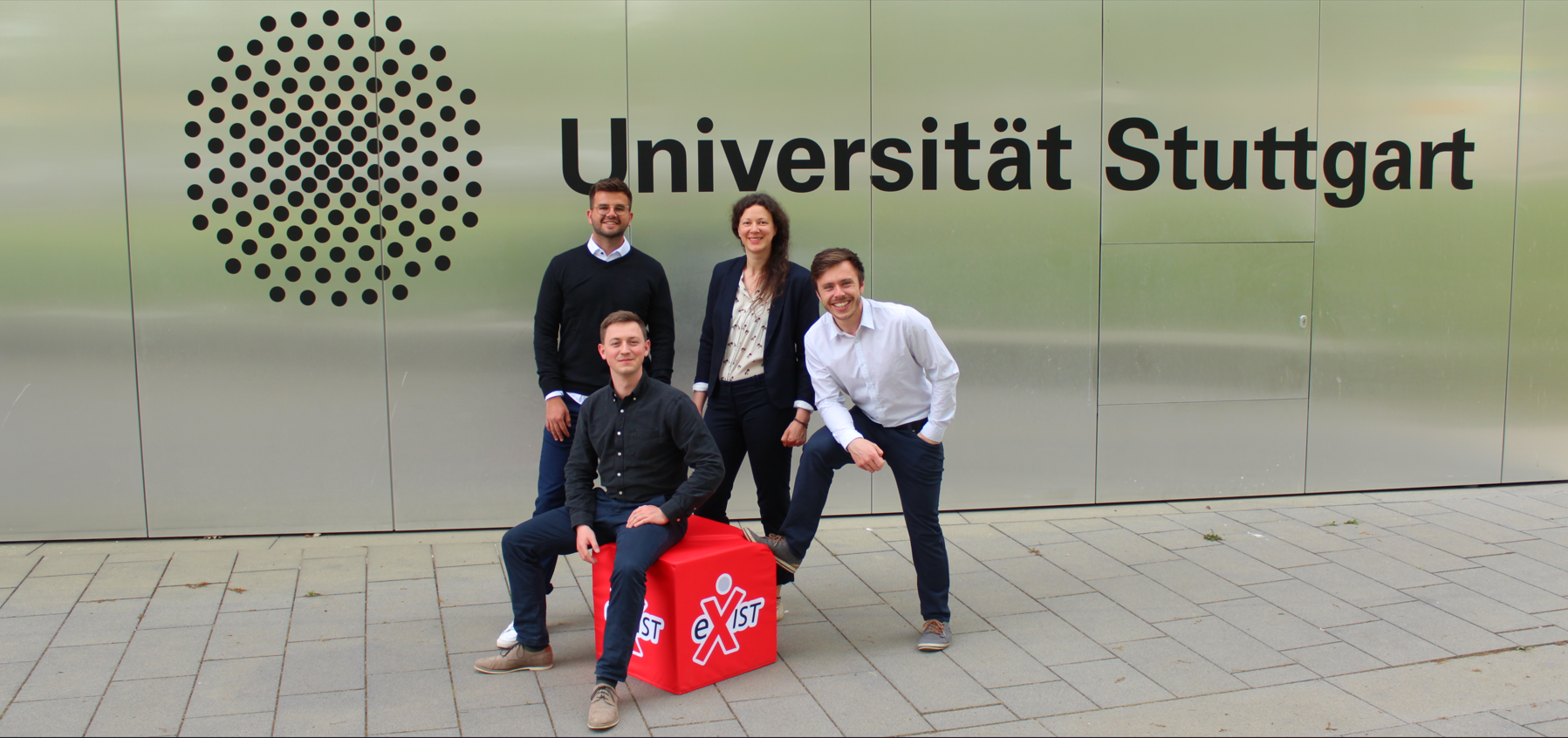
Cyclize, a spin-off project from the University of Stuttgart, has been awarded funding under the German Federal Ministry for Economic Affairs and Climate Action’s EXIST Research Transfer programme. The founding team is developing a plasma-based process that allows the chemical industry to replace natural gas with a combination of plastic waste and CO₂ as a carbon source for new products.
Replacing Natural Gas with Plastic Waste and CO₂
Almost all everyday products are still based on natural gas and crude oil. Reducing natural gas demand in the chemical industry is therefore crucial for climate protection and energy independence. Cyclize addresses this challenge with a new process that can use mixed plastic waste and CO₂ from industrial exhaust gases as a substitute for natural gas.
The technology enables the production of basic chemicals and materials such as plastics, foams, adhesives, paints and coatings without fossil feedstocks, while at the same time avoiding CO₂ emissions and valorising waste streams that are currently incinerated.
Non-thermal Plasma as the Key Technology
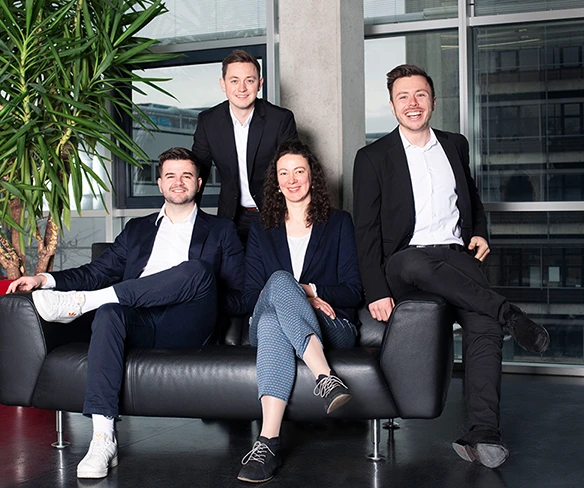
The process was invented by three young researchers from the University of Stuttgart’s Institute for Photovoltaics (IPV): Maike Lambarth, Stephan Renninger and Jan Stein. Together, they founded Cyclize and aim to address three central challenges in a single process:
- Replace natural gas in the chemical industry with non-fossil alternatives
- Utilise the annually growing volume of plastic waste in a meaningful, holistic way
- Establish a CO₂ sink by using CO₂ from point sources (e.g. cement plants) as a carbon resource
Cyclize uses a non-thermal plasma, generated by self-developed, efficient power electronics. In a first step, the plasma gasifies plastic waste and other carbon-rich residues. The resulting hydrocarbon–CO₂ gas mixture is then reformed into synthesis gas (syngas)—a mixture of carbon monoxide and hydrogen.
“Using our process, the chemical industry will not become carbon-free, because carbon atoms remain in the products themselves,” explains Maike Lambarth. “But by switching to non-fossil carbon sources and electrifying the underlying processes, it can become defossilised.”
Drop-in Replacement for Conventional Syngas
Syngas is an essential intermediate for the production of basic chemicals and fuels. Today, it is typically produced from natural gas via steam reforming. Cyclize’s process can generate syngas from plastic waste and CO₂ with equivalent functionality. “Our Cyclize process can act as a drop-in replacement for conventional natural-gas-based syngas,” says Lambarth. “This opens the door to a more circular carbon economy in the chemical sector.” By combining mixed plastic waste with CO₂ from exhaust gas streams and feeding both back into the carbon cycle, the process offers a pathway to significantly reduce CO₂ emissions and dependency on fossil resources.
EXIST Research Transfer to Scale the Technology
Because of its high potential for enabling a circular economy for carbon, the Cyclize team has been selected for EXIST Research Transfer funding since May 2022. The programme supports outstanding, research-based start-up projects that require extensive and technically risky development work on the way to market.
“We will use the funding to scale our process and bring it to industrial maturity,” says Lambarth. “Our goal is to develop the technology to market readiness and, in doing so, enable a truly holistic circular economy for carbon. If we succeed as planned, both the economy and society will benefit.”
The team has one and a half years to advance the technology within the scope of the EXIST funding.
Strong Support from Business and Academia
The three researchers are supported by Dominik Novakovic, a business economist who contributes his experience from advising deep-tech start-ups, and by Professor Kai Peter Birke from the Institute for Photovoltaics, who brings his own start-up experience into the project.
The founders have already been working on plasma technology for a sustainable future for around three years. Their bridge to industry is CHEMampere, a Stuttgart-based initiative focused on the electrification of the chemical industry.
About Cyclize
Cyclize is a spin-off project from the University of Stuttgart that develops a plasma-based process to convert mixed plastic waste, other carbon-rich residues and CO₂ into synthesis gas for the chemical industry. By replacing natural gas as a carbon source, Cyclize aims to defossilise chemical value chains and enable a circular economy for carbon.